
Long conversations
with people who build things.
Interviews with coaches, authors and influencers who stopped doing everything themselves, about what actually works: the unglamorous systems behind businesses that keep growing.
People who packaged what they know.
They put a name on it
Authors and builders who took what they knew, turned it into a book or a tool with their name on it, and put it up for sale.
How they got known
How they got in front of people, and what they did with the attention once they had it.
The parts nobody shows
What it cost them to learn it, said plainly, so the next person does not pay for the same lesson.
I have run a podcast since 2008. Here is what it does for you.
Started in 2008. I started recording these conversations in 2008, long before a podcast was something everybody had. I was not trying to be a radio host. I had been running businesses for years by then, and I had learned that the fastest way to get better at anything is to sit down with somebody who has already done it and ask them how. A podcast gave me a reason to ask. The interviews further down this page come from those early years, and I have left every one of them up. You can watch them today exactly as they were recorded.
Time builds trust. A short clip gets you noticed. It does not get you paid. People need to see you and hear from you seven to ten times before they will hand over real money, and a clip is one of those times at best. A long conversation covers a lot of that ground in one sitting. The listener hears how you think, how you talk, and whether you actually know your subject. They hear you get a hard question and answer it without a script. By the end they feel like they know you. Think about the people you trust and have never met. Chances are you have spent hours listening to them.
A short clip gets you noticed. It does not get you paid.
The company you keep. Your show can be you alone, talking about what you know. It gets stronger when you bring somebody on now and then. When you sit across from a person who wrote the book or built the company, some of their credibility lands on you. The listener sees you asking good questions of somebody they already respect, and they put you in the same room in their head. There is a second benefit. When a guest shares the episode with their own audience, you are in front of people who had never heard your name, introduced by somebody they already trust.
You already said it. Ask anybody with a following what wears them down and you will hear the same thing. It is thinking up something new to say every single day. A long conversation fixes that at the root. In one sitting you answer question after question, tell the stories behind what you teach, and explain the thing you explain to every new client. That is a lot of material, and you did not sit down and write any of it. You said it out loud, on the record. That is why the podcast is what feeds system two of our proprietary Revenue Engine, the Automated Organic Content Engine. You stop staring at your phone wondering what to say today.
Not on rented land. Every social platform is rented land. You can build something good there, but the landlord sets the rules, and a landlord can change them or lock the door without asking you. A clip in a feed also has a short life. It is seen for a little while and then it is buried. An episode on a website you own does not expire and does not answer to anybody. Somebody can find it years from now and it still does its job. You are looking at the proof. The interviews on this page were recorded a long time ago and they are still working for me. Yours will sit on your website, doing that same job for you and bringing people to what you sell long after the day you recorded it.
It costs next to nothing. Here is what surprises people. The places that carry a podcast today charge you nothing to be on them. There is no airtime to buy and nobody to ask for permission. What a show costs now is work. Somebody has to set it up properly the first time, and then somebody has to keep it going, episode after episode, long after the excitement of the first one has worn off. That second part is where most shows end. So the price of a podcast is no longer money. It is know-how and staying power, and you can have both without supplying either one yourself. That is the part my team and I take off your plate.
A modern day talent agency. When somebody asks me what I do for a living, that is the answer. My team and I are a modern day talent agency, and the podcast is where you can see it most clearly. A talent agent's job was always to get the talent on a show. We go one better and build you the show, with your name on it, on a website you own. Then we do what a good agent does after the booking. We package what you know into something a person can buy, and we build the website and the sales system that sells it. That sales system is the Revenue Engine. We show you how to promote yourself, and then my team does the heavy end of it for you. Whatever you do for a living, you need self-promotion to make it work, and your own podcast is where it starts.
Every episode is below. Watch the interview, then go get their book or their tool. The conversation, the guest and the thing they sell sit side by side, on a website I own. That is on purpose. A person comes for the conversation and finds something to buy right beside it. My team and I produce a podcast like this for every client, on their own website. On your page, the thing for sale is yours.
Personal Brand & Marketing
Interview with Lewis Howes
Author of LinkedWorking
About the book
Lewis took one platform, LinkedIn, and one skill, meeting the right people, and wrote the book on it with a co-author. That is the first thing to notice. He did not try to cover everything. He picked a narrow subject and owned it.
His point is plain. There are no secrets and no tricks. You treat people online the same way you would treat them across a table, and the doors open the same way they do in person.
In LinkedWorking, he and his co-author show how to set yourself up so the right people find you, how to spot the contacts who lead to more contacts, and what to do once you have them. All of it runs on habits you already use every day.
LinkedWorking is also a lesson in packaging what you know. One subject, one book, his name on the cover.
Interview with Tamar Weinberg
Author of The New Community Rules: Marketing on the Social Web
About the book
Tamar wrote about the social web when a lot of companies still had not worked out what to do with it. Her question was simple. All these people are gathered in one place, and it costs nothing to stand in front of them. So how do you reach them the right way? The New Community Rules explains how these communities work and the practical ways to reach the people who spend their time there.
It skips the hype and the jargon. She gives straight advice on where to stand and what to say, and she backs it with examples of companies that had already tried it.
She covers how to get your name known in short messages and long ones. She covers why honesty wins on social media and a sales pitch loses. She covers looking after your reputation. And she saw that video and podcasts were where the influence was heading.
For a coach, an author or an influencer, the lesson holds up. You join the conversation, you give something to the community first, and then you bring people to what you sell.
All Things Technology

Interview with Blair Williams
Developer of the PrettyLinks WordPress plugin
About the tool
Blair built a tool for a problem every person with a following has. You get one link in your profile, and you have a lot of things you want people to see. His answer is one page, on a website you own, that holds every offer and every product you recommend.
You lay it out the way you want and make it look like you, and it counts every tap so you know what people actually care about. He knew a problem well, built the fix, and put it up for sale. A product does not have to be a book.
Money, Property and Protecting What You Build
Interview with Alexis Martin Neely
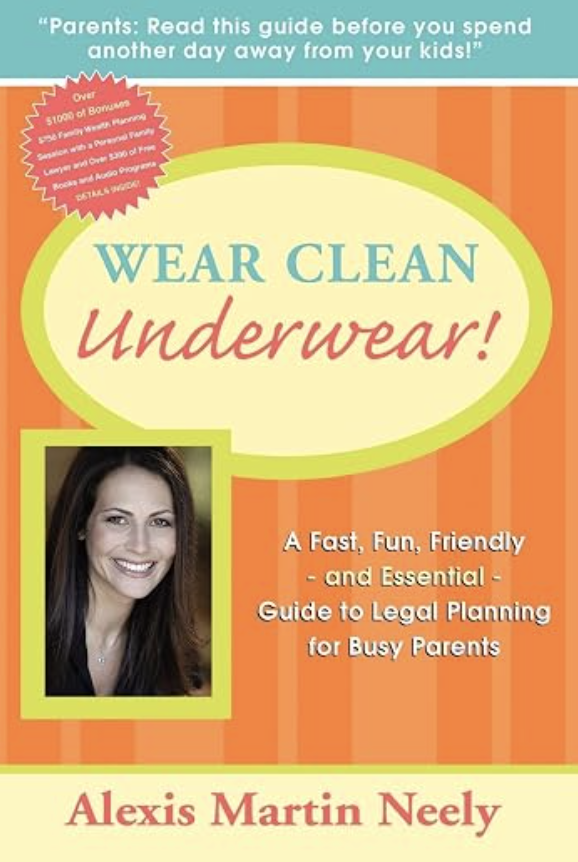
Author of Wear Clean Underwear
About the book
Alexis wrote this one for parents. Her point is that most of us plan the birthday parties, the playdates and the schooling, and never plan for the one day we do not want to think about, the day we are in an accident.
She asks the questions nobody asks. Who has your children in the first 24 hours, while the officials are still finding your family? Are they with people you know and trust? What happens to your money and your home? Will your paperwork hold your family together or pull it apart?
She wrote Wear Clean Underwear as a story that reads fast and simple. It shows what happens with the plan you have today and what happens with no plan at all, and how to pass on your values along with your money. She took a heavy subject and packaged it so a person wants to pick it up. That is the skill.
Interview with Paul Damazo
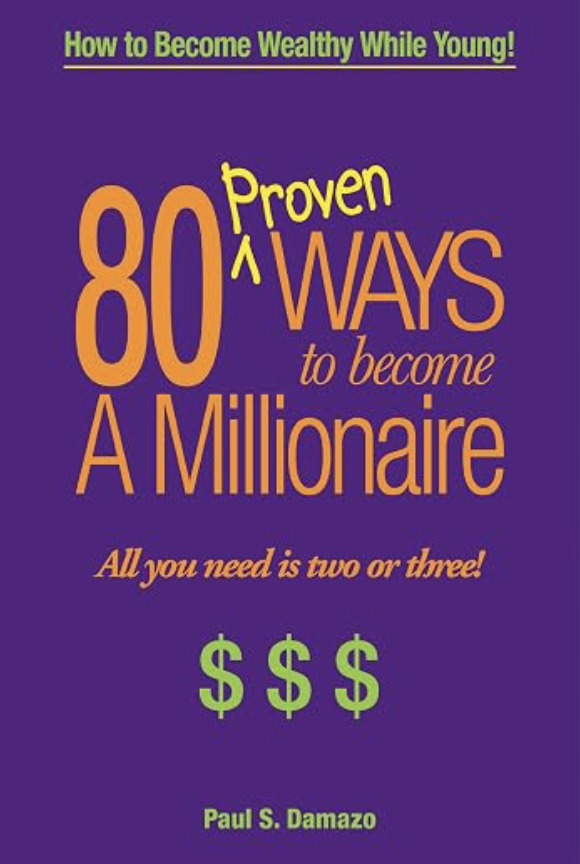
Author of 80 Proven Ways to Become a Millionaire
About the book
Paul put what he knows about money into one book. He starts with the old story of the richest man in Babylon, the man whose wealth grew faster than he could spend it, and works forward from there. He writes for newlyweds, for people who are starting late, and for people already retired who still want more than one stream of income. The thread through all of it is getting your money to work for you instead of you working for your money.
He calls it finances from the womb to the tomb, and he means it. Single, married, divorced, with children or without, there is something in it for where you are. His aim is for you to take charge of your own money, and to hand what you learn to your children and grandchildren.
He also believes it is bigger than one household. If more people got out of debt and saved and invested for themselves, he says, the whole country would feel it. You do not have to agree with every idea in a book to see what he did. He took what he knew, put his name on it, and it is still here for sale.
My team and I produce a podcast like this for you, on your own website.
What you are getting. Every client we work with gets their own show. It carries your name and it lives on your website, laid out like the page you are reading now. This is not a guest spot on my podcast. It is the stage you sell from. Here is what arrives. The show, set up from scratch. Its home on your website. Every episode produced and put up for you. The clips cut from each one. And your own e-book, with your name on the cover, for sale beside every episode. It comes with the build whichever way you work with us, done for you or the Revenue Share Partnership. It is a copy of my business, front to back, built to turn the people listening into people paying.
Why most never start. Plenty of coaches, authors and influencers have thought about a podcast. Many never record one, and many who do stop after a few episodes. It is rarely because they have nothing to say. It is the work around the talking. Setting it up. Cleaning up the recording. Cutting it down. Getting it onto a website. Getting clips out everywhere. It piles up, they fall behind, and the show dies quietly. That is a labor problem, not a talent problem. You bring the talent. Handling everything around it is what a talent agency is for.
What you do. For the show, your job is to sit down and talk about what you know. You pick the subjects, because nobody else can say it for you. A good place to start is the questions people already ask you all the time. Some episodes can be just you. If you want a guest across from you, you choose who. You do not edit anything. You do not learn a new program. You do not figure out where the recording goes when you are done. Past the show, your part is short. You record, you take calls with people who are ready, and you take care of your clients. If you can hold a good conversation over coffee, you can do this.
What we do. Everything else. My team and I set the show up from scratch and build its home on your website. After you record, we clean up the conversation and turn it into a finished episode. Then we cut it into short clips for Facebook, Instagram, TikTok and YouTube and put them out for you, each one pointing back to your website. Every episode gets its own spot on your page, with your e-book sitting right beside it. AI employees do the heavy lifting, my team checks the work, and I am personally on your account. We are a US company with a team behind this, and every episode you record gets the whole team's work.
Your week afterward. Once it is running, your week gets simpler, not busier. The recording is the only part of the show that needs you. After that you go back to coaching, writing, speaking, or whatever it is you are actually good at. Meanwhile the episode goes up and the clips keep showing up in front of your audience, including on the days you do nothing at all. You are no longer the person who has to remember to put something out. Your followers hear from you again and again, and you only had to say it once. And when a busy stretch comes, what is already on your website keeps working, the same way my old interviews do.
Where it leads. A podcast with nothing behind it is a hobby. Ours is the front end of the Revenue Engine. The episode and its clips bring people to your website, and your e-book is for sale there. When somebody raises a hand with a question, an AI employee answers in seconds, day or night. That system is called Speed to Lead. The people you have already helped get asked to say so, and their words sit where the next visitor sees them. That is Automated Five Star Reviews. And the listeners who showed interest and then went quiet get reached again with something new to offer. That is CRM Mastery. That is how a listener becomes a paying client instead of one more follower.
A podcast with nothing behind it is a hobby. Ours is the front end of the Revenue Engine.
A fair warning. If having your own podcast and your own product scares you, we are not the right fit, and I would rather tell you that now. You do not have to be polished. You do not need a radio voice. The honest episodes are always the best ones. You do have to be willing to sit down, be heard, and put your name on what you know. If that is you, there are three ways in. Do it yourself is my book, the blueprint, $495.00, for the person with more time than money right now. Done with you is the Revenue Share Partnership, $3,995.00 to start, for the person with real talent who cannot write the full check today. Done for you is $40,000.00 to $60,000.00. In those two, my team does the work: your own show, your website, your e-book and all six systems of the Revenue Engine. Every client starts with a discovery call, and the exact price is set on that call. If you would rather tell your story on my show, the guest form is at the bottom of this page.
If you want your own show built, apply here, and if you have a story for mine, keep scrolling.
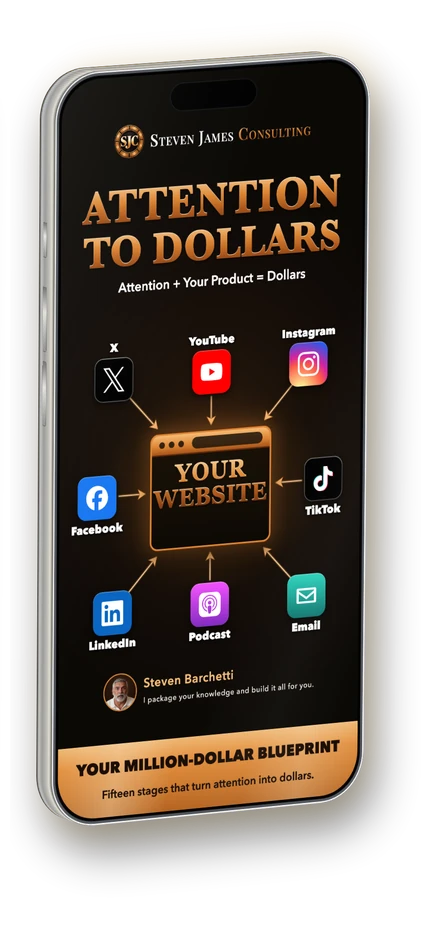
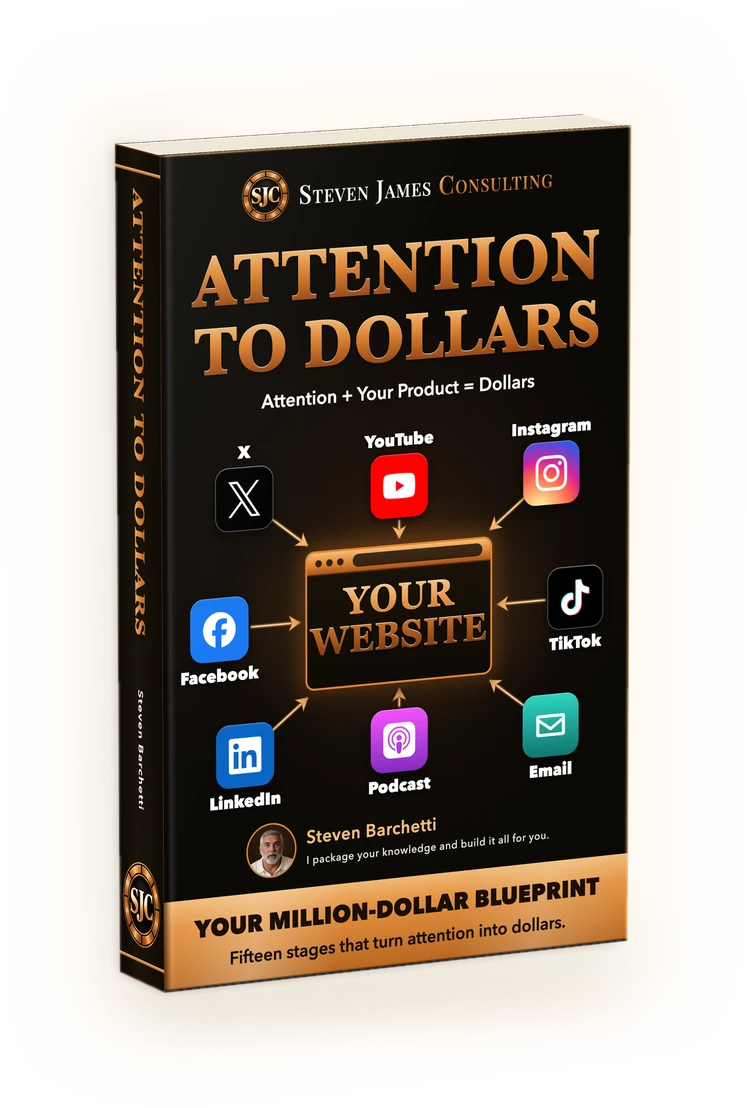
Attention To Dollars
What you know is worth money. This book shows you how to collect it. It is the blueprint, start to finish: take the attention you already have, package what you know into something people can buy, and sell it from a website you own.
The whole method is in it. Every system, every step, in the order we build it. The blueprint is $495.00. It comes with a study guide sized for your phone, your tablet and your laptop.
We are always looking for interesting people.
A few quick questions so we can make it a great conversation. It takes under two minutes.
If you built a program, a book or a following and have a story worth telling, especially an expensive lesson, get in touch. The best episodes are the honest ones. You do not need a big name or a polished pitch. You need something you built, what it cost you to learn it, and the willingness to say it plainly so the next person does not pay for the same mistake. Your book, your program or your tool goes right beside your episode, the same way you see it laid out above.
Want to come on the show?
Tell me the story you'd want to get into. I read every one of these myself.