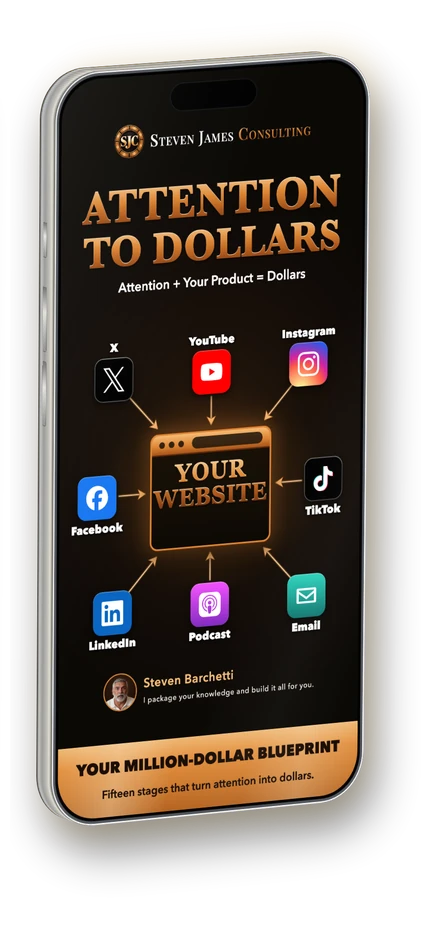
System 2 of 6 in our proprietary Revenue Engine
Your social media should send followers
to the website you own.
Facebook, Instagram, TikTok and YouTube are free, and your audience is on them every day. We use your profiles there to send those people to your website, the one place online you own and the one place they can buy from you or book a call. Most coaches, authors and influencers put something out when they get a spare minute, and it dries up the week a launch gets busy. We turn every recording you make into a month of videos, clips and captions in your own words. You approve them on your phone, they publish on schedule, and every one points home. We also produce your own podcast. It lives on your website, just like mine, and every episode gives us more to cut from.
Automated Organic Content Engine is one of six systems we build. They are designed to connect, so nobody who raises a hand gets dropped between them.
The Automated Organic Content Engine: what is typical, what you get, and the money.
Every day on our live stream we show the difference between how most people do it and how the people making real money do it. Here is that difference for this one system. Most of our clients sell a product at about $10,000.00, so the money lines below use that price. They are examples to show the math.
Showing up
What is typical: Showing up when there is a spare minute, then disappearing for weeks. Your audience forgets you between visits.
What you get: You record once. My team turns that one recording into a week of clips on every platform you keep.
The money: Say it puts an extra hundred thousand sets of eyes a month on you and your offers. Call it five clients a month. That is $50,000.00 a month.
Where a clip sends them
What is typical: A clip gets watched and the viewer scrolls on. The attention stays with the platform.
What you get: Every clip sends people to your website through its own smart link, where they can leave a name, book a call or buy.
The money: Attention that lands on your website becomes a name on your list. Attention that stays on the platform becomes nothing.
Your show as the source
What is typical: No show, so every clip is made from scratch, one at a time, by you.
What you get: Your podcast and your live show are the source. Every episode becomes clips, so one hour of you talking feeds every platform for the week.
The money: Millions of dollars are left on the table by people who know their subject and never had their own show.
Being seen enough times
What is typical: People see you once and forget. Almost nobody buys the first time they see somebody.
What you get: They see you every day, saying the same thing in a new way, until you are the name they think of.
The money: The buyer who has seen you ten times does not need selling. Five of those a month is $50,000.00.
How it stacks
The content engine is stage nine of the fifteen. It runs on your show from stage eight, and it needs your product from stage four so there is something to send people toward. Everything it produces points at your website in stage seven, fills the email list from stage one, and gives CRM Mastery in stage eleven more names to work. Paid Ads, in stage twelve, only ever adds to what this already does for free.
One system on its own does a little. All of them connected is where the $50,000.00 keeps stacking.
One recording becomes a month of content.
Why free attention comes before paid attention.
What it costs now. For most of my forty years in business, attention was something you bought. That is not where you are standing. The platforms your followers are on every day charge you nothing to be in front of them, and your own podcast costs next to nothing once my team sets it up. So the price has moved. It is no longer money. It is being there every week, with something worth watching, long after the novelty wears off. Most people cannot keep that up alone, and that is the only reason free attention goes to waste. Keeping it up is the part this system takes off you.
Self-promotion, done for you. My team and I are a modern day talent agency. Being seen is free now. Knowing how to get seen, week after week, and get paid for it, is still a skill. Whatever you do for a living, you have to do self-promotion to make it work, and most people were never shown how. This system is the self-promotion, done for you. You talk about what you know. We make sure the right people see it, over and over, and we send them to the place where they can pay you.
Being seen is free now. Knowing how to get seen, week after week, and get paid for it, is still a skill.
You did the hard part. You already have followers. Those people chose to watch you. Nobody paid to push you in front of them. That is the most valuable attention there is, because it comes with some trust already built in. A person who followed you on purpose is partway to buying before you say a word. Paying to reach strangers while the people who already like you only hear from you now and then is doing it backwards. So we start with the crowd you have already earned.
Free shows what works. Every video you put out is a small test that costs you nothing. Some of your stories make people stop, watch and come over to your website. Others get a polite nod and a scroll. Over time we learn which of your lessons make people move, and we make more of those. When advertising gets added later, as the sixth system, we are not guessing what to put money behind. By the time a dollar goes behind a message, your own audience has already told us it works.
It keeps working. An ad stops the day you stop paying for it. A video does not. A clip you put out this month can still be found long after, by somebody typing what you teach into Google. A podcast episode sits on your website for as long as you want it there. Every piece adds to a library with your name on it, and that library points at a website you own. That is the difference between renting attention for a week and building a library that keeps sending people to you.
Your face, your words, a full month of clips. Every clip points back to your website.
Your audience followed you for your face, your voice and the way you explain things, so that is what goes out. Every clip is you, saying what you already teach, in the words your clients know you for. What we add is the part nobody has time for: turning one recording into a month of pieces, writing the captions and titles in the words your audience actually types, and getting them out on a schedule. That is self-promotion, done for you, and every piece of it sends people to the website where they can buy from you.
We report on what your videos sent to your website and what that turned into, not on how many people liked a clip. Because my team built the website and the answering too, we can see the whole trip, from the clip to the call. If people watch and do not come over, we change the clips. If they come over and do not buy, we change the page. Each month is built on what the last one taught us about your buyers.
Premium Smart Websites — see how it works → · Speed to Lead — see how it works →
What lands in front of you every month.
One recording, a month of clips
You sit down once and talk about what you teach. What comes back is the whole month, finished: short videos, written pieces and captions, ready for your yes.
Your voice, not a template
If a piece does not sound like you, tap it and say what to change. It comes back fixed before anything goes out under your name.
Every piece points to your website
Every piece sends people to your website, not to a profile somebody else controls. Your website is the one place they can buy from you or book a call.
Almost nobody buys the first time they see you. This is how you get to the tenth.
Think how you buy. Think about the last time you paid real money to somebody you found online. You probably did not do it the first day. You watched a few of their videos. Maybe you listened to them talk for a while. You saw their name again the next week. Somewhere along the way they stopped being a stranger and became somebody you felt you knew. People need to see you and hear from you seven to ten times before they trust you enough to pay. Your followers are no different from you.
Where it breaks down. Most coaches, authors and influencers show up in bursts. A strong week, then a quiet month, because a launch, a client or plain life got in the way. Look at that from your follower's side. They saw you a few times and then you went silent. They were not telling you no. They simply never got to seven. The trust you were building cooled off, and the next time they see you it has to start over from the beginning.
The schedule keeps count. With this system running, a month of videos, clips and written pieces is made and approved before the month begins. Something with your face and your words goes out on a steady schedule whether you are busy, traveling or flat on your back with a cold. So the follower who found you in the first week sees you again, and again after that, without you remembering to make it happen. The seven to ten times now happen on a calendar instead of on your willpower.
The seven to ten times now happen on a calendar instead of on your willpower.
The podcast goes deeper. A clip is a short hello. A podcast episode is a person choosing to sit with you for a long stretch, in the car or on a walk, hearing how you think and how you talk. That builds a kind of familiarity a short video cannot. So you get both. The clips keep you seen often. The episodes let people get to know you. And both end in the same place, which is your website, where your e-book and your program are for sale.
Who shows up. By the time somebody comes to your website, they are not a cold stranger. They have heard your stories. They know what you believe and how you explain things. They came on purpose. That is a very different conversation from trying to convince a person who has never heard of you. What you teach already works. This is what gives people enough time with you to believe it.
If a finished month waiting on your phone for a yes sounds right, apply here.
Why this one is number two.
You record. Everything after that is ours.
You record
You sit down with your phone and talk about what you teach: a win a student just had, a question a follower asked, what people get wrong. No script, no studio.
We make the whole month
One recording becomes short videos, written pieces, captions and titles, around thirty in all, each one cut and sized for the place it will be shown.
You approve it on your phone
Everything waits in one place. Tap yes, or say what to change.
It goes out without you
On a schedule, to the accounts you choose, including launch weeks and the weeks you are on the road.
We watch what people did next
Not likes. Who came to the website, what they read, and who booked a call or bought. Next month is built out of what worked.
What actually happens to every recording, and to every podcast episode.
It starts with you talking. You do not need a topic calendar or a big idea. You talk about what you already talk about all day: the question you answered twice this week, the thing you wish every new client knew before they started, the story you end up telling on every sales call. If you are not sure where to start, we will tell you which of last month's topics sent the most people to your website, and you can pick up from there. You talk like you would to a client across the table. That is the voice your audience followed in the first place.
One talk, many ideas. When you sit down and talk about what you teach, you do not say one thing. You tell a story. You answer a question. You make a point you have made to clients over and over. You warn people off a mistake. Each of those stands on its own, so we find each one and lift it out. One becomes a short video. The same idea becomes a written piece for people who would rather read. A strong sentence becomes a caption. That is how one sitting turns into around thirty pieces. Every one of them is a real idea of yours. We are separating out what was already in there.
Every piece gets finished. A raw clip is not a finished piece. Each one gets cut to the right length and shape for where it will be shown. Each one gets a caption, and a title written in the words people actually type when they go looking for what you teach. That is slow, fiddly work, and it is the reason most people quit. AI employees do it for you day and night, and my team checks it before you ever see it. You only see the finished pieces.
Your podcast feeds it. We also produce your own podcast, and it lives on your website, just like mine. You show up and talk. My team does the technical work of setting it up, editing it and putting it on your website. Then each episode goes through the same steps as your ten minute recording. A longer conversation has more stories and more answers in it, so every episode gives us more to cut from. One sitting gives you a full episode and a stack of clips that point people back to it.
An expert's income is a direct reflection of the time and effort they put into their business.
What your week looks like. An expert's income is a direct reflection of the time and effort they put into their business. The more you record, the more we have to work with. You record. When the month is ready, it waits on your phone, and you tap yes or say what to change. The rest of the time your videos go out while you coach, write, travel or take a day off. You will see yourself showing up online on days you never thought about it once.
The website first, then the content, then the rest. If that order makes sense to you, apply.
Know what you own
and what you are only renting.
This is the whole argument. A social account is borrowed space. The rules change, the reach changes, and one morning the account can be gone and the audience with it. You can spend years building a following on a platform and still own none of it. Your website is different. It is your own piece of digital real estate, the one place built to sell what you know, and the one place a person can actually buy from you. So we use the free platforms for what they are good at, which is getting you seen, and we point everything they give you at the place you own.
Search engine optimization (SEO)
Getting found by the people typing what they need into Google. The titles, captions and descriptions we write use the words people looking for what you teach actually type, so the same recording also makes you easier to find. Most of what gets put out ignores that entirely.
Organic reach (free attention)
Attention you did not pay for. Somebody watched because it was worth watching, not because money pushed it in front of them. It does not switch off the day you stop spending, which is why this system comes before paid ads, and keeps working when the ads are off.
Your own website (the front door)
The only thing on this list you own outright. Every clip and video points there, because that is where somebody can buy from you or book a call, and it is the one address where your e-book, your podcast and your program all sit together.
What this system hands to the next one.
Attention makes noise. When your videos go out steadily, people respond. A comment under a clip. A private message asking how to work with you. A form filled in on your website late at night. Each one of those is a person raising a hand, and getting hands raised is the whole job of this system. It is also the spot where most sales are lost. The hand goes up while you are asleep or with a client, and by the time you see it, the interest has cooled.
System 3 catches it. That is why the third system in the Revenue Engine is Speed to Lead. An AI employee answers every comment, message and form in seconds, day or night, while the person still cares. The content engine gets the hand raised. Speed to Lead makes sure somebody is there when it goes up. One without the other is half a system, and half a system is what most people with an audience are running today.
What we watch. We watch what people did after they watched you. Not the likes. Who came over to your website, and who raised a hand once they got there. Say a clip where you answer one common question sends more people over than anything else that month. Next month we ask you to talk more about that, and we cut more from it. The topic that only drew a polite nod gets less room. That is how your content gets sharper every month, and how the systems after this one get better people to work with. Six parts, one engine, each one handing off to the next.
We get you seen, we package what you know, and we show you how to sell it.
What you end up with. You end up with a copy of how my own business runs, with your name on it. Your website. Your e-book for sale on it. Your podcast living on it. And the free platforms sending your audience there on a steady schedule. That is what a modern day talent agency does. We get you seen, we package what you know, and we show you how to sell it. You keep doing the part only you can do. If having your own podcast and your own product scares you, we are not the right fit. If it sounds like the piece you have been missing, the application is below. Every client starts with a discovery call, and that is where you get your exact price.
You talk about what you know. My team and I do everything after that.
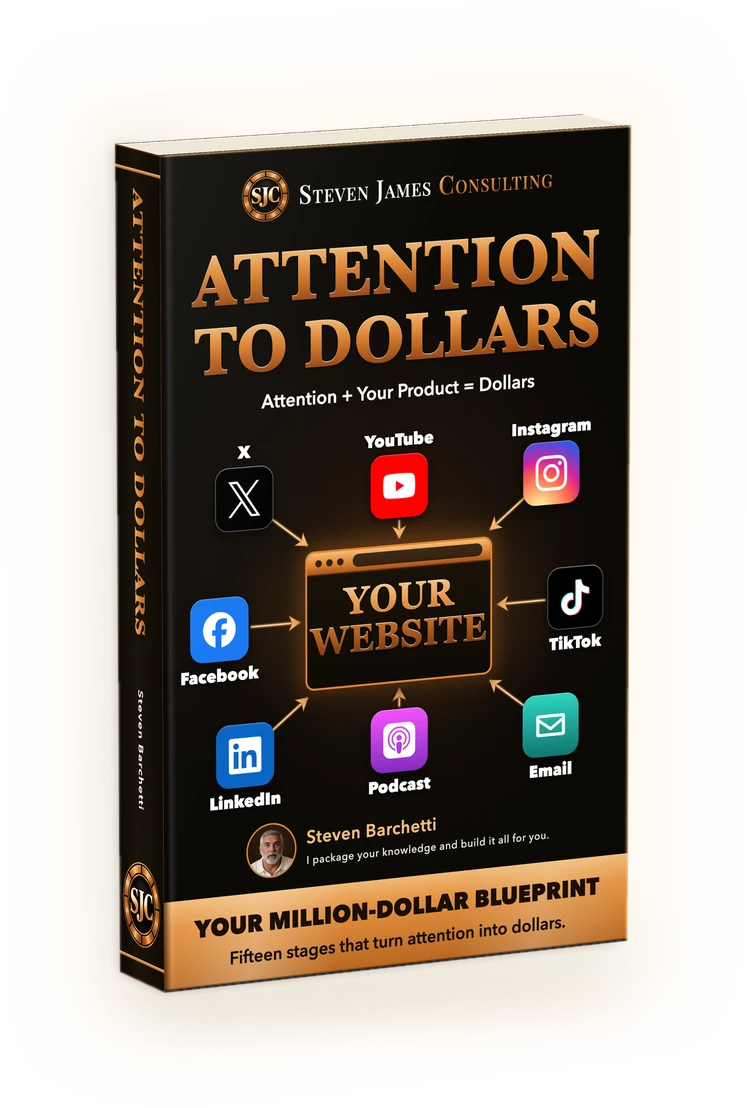
Attention To Dollars
What you know is worth money. This book shows you how to collect it. It is the blueprint, start to finish: take the attention you already have, package what you know into something people can buy, and sell it from a website you own.
The whole Revenue Engine is in it. Every system, every step, in the order we build it. The blueprint is $495.00. It comes with a study guide sized for your phone, your tablet and your laptop.