
System 6 of 6 in our proprietary Revenue Engine
You are paying for leads
that nobody ever calls back.
Most coaches, authors and influencers who tried ads got a pile of names, chased a few of them, gave up, and decided ads do not work for what they sell. Ads work fine. What went wrong happened after the person raised a hand: the message sat in an inbox until they had already bought from someone else. Once your free attention is turning into sales, we build and run the campaigns on Facebook and Google, then answer every person who comes back in under a minute, day or night, until they book. Every ad dollar goes behind the message that already made people book. What lands on your calendar is sales calls, not a list to chase. The ads send people to the website we built for you, where your own e-book and your own podcast are waiting.
Paid Ads = Booked Appointments is one of six systems we build. They are designed to connect, so nobody who raises a hand gets dropped between them.
Paid Ads = Booked Appointments: what is typical, what you get, and the money.
Every day on our live stream we show the difference between how most people do it and how the people making real money do it. Here is that difference for this one system. Most of our clients sell a product at about $10,000.00, so the money lines below use that price. They are examples to show the math.
When the ads get turned on
What is typical: First. Strangers get sent into a business that is missing the eleven stages before this one. That is how people lose money on ads.
What you get: Last, and only if you want them. By then the ads send more attention into a system that already works.
The money: With the rest working, every five clients a month that ads add is another $50,000.00 a month.
What comes back
What is typical: A list of names. Somebody has to chase them, most never answer, and you decide ads do not work.
What you get: Calls on your calendar. Every person who responds is answered in seconds and followed up until they book.
The money: A booked call with somebody who already knows your work is worth more than a hundred names nobody called.
What the ads say
What is typical: A guess. Somebody writes an ad and hopes.
What you get: The ads are built on what your own audience already said yes to: the offers they bought, the questions they asked and the words that got an answer.
The money: You stop paying to find out what works, because your own list already told you.
Knowing your number
What is typical: No idea what a buyer costs you, so no idea when to spend more.
What you get: Every campaign is built to one number: what a buyer costs you. When you know it, you know exactly when to turn the spending up.
The money: When a $10,000.00 client costs you a known amount to get, more ad money stops being a risk and becomes a decision.
How it stacks
Paid Ads is stage twelve of the fifteen, last of the six systems on purpose. The whole system is built to run on attention that costs you nothing. Ads pour more people into the website from stage seven, they are answered by the AI employees from stages two and six, the proof from stage ten is what the ads show, and every name the ads bring in goes into CRM Mastery in stage eleven.
One system on its own does a little. All of them connected is where the $50,000.00 keeps stacking.
We put booked sales calls on your calendar.
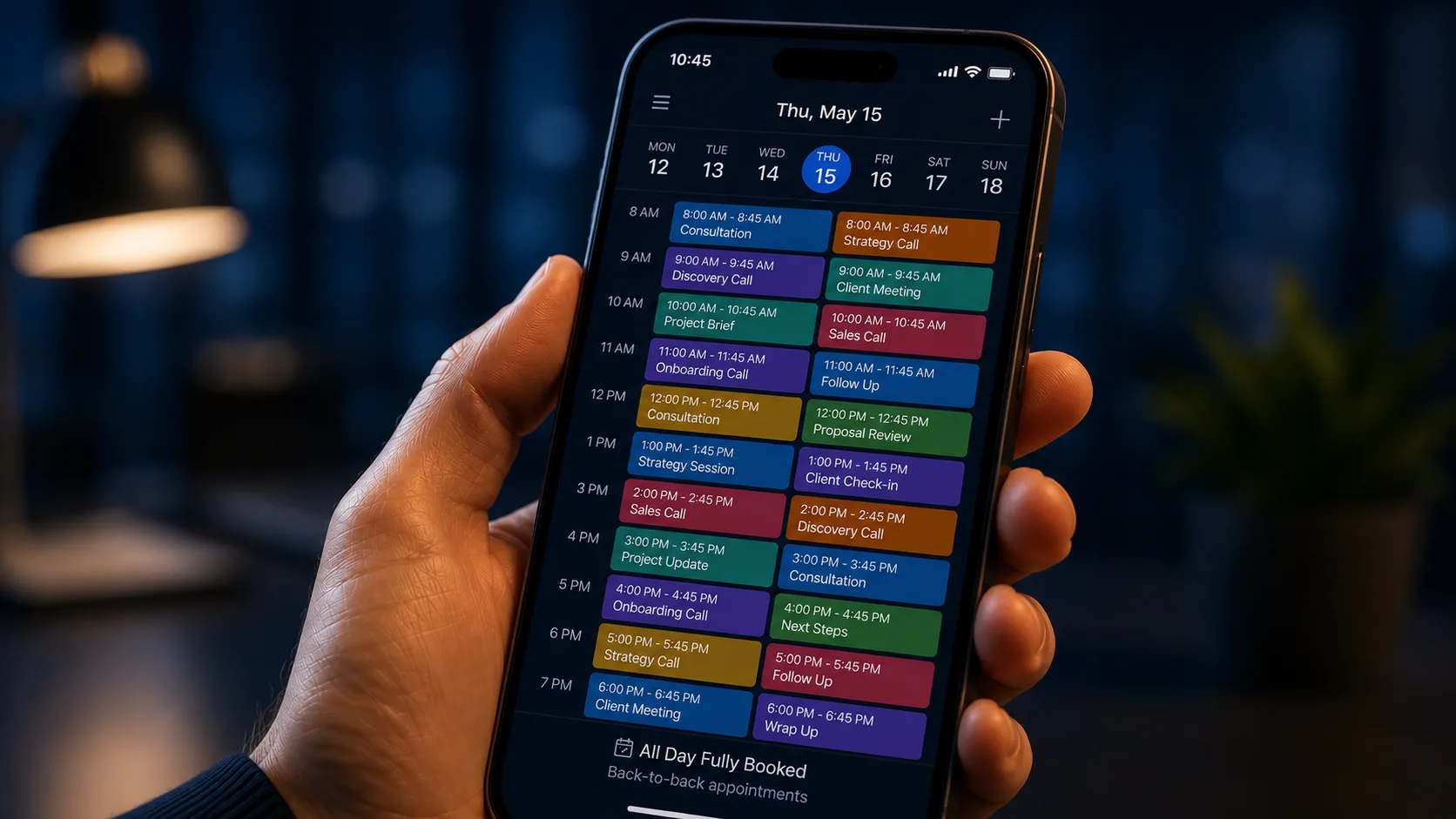
What a call on your calendar is worth, next to a list of names.
A list of names. Picture the thing itself. A sheet with rows on it. A name, a phone number, an email address, and the date they filled out a form. That is what most paid advertising hands you, and it looks like progress. But every row is a person who was curious for one moment, and the moment is usually over before you open the sheet. Now the rows are your job. You call the first one after dinner. You text the second. By the tenth it is late and nobody has picked up. You paid for the sheet, and then you paid again with your evenings.
A booked call. A booked call is a different animal. This person saw you, asked a question and got an answer right away. They asked another one and got that answered too. Then they looked at your calendar and picked a time. They know who you are and what you teach. They have been on your website. Some of them have already bought your e-book or listened to an episode of your podcast. By the time you say hello, the hardest part of the sale is behind you.
By the time you say hello, the hardest part of the sale is behind you.
Why it matters for you. You sell something that takes a conversation. Nobody hands real money for a program to a stranger they saw in an ad five minutes ago. They want to talk to you, or to somebody on your team, and decide if you are the right person to help them. So the conversation is the only thing worth counting. A click is a step toward it. A form is a step toward it. When what you sell is a program, one good conversation can be worth more to you than a whole sheet of names, because it is the only place a person ever says yes.
What you do. Your part is small on purpose. You show up to the call and talk to somebody who wants help about whether what you teach is right for them. That is the work you are already good at. Everything that happens before that moment is done for you: the ad, the answer, the follow-up, the reminders, the booking. AI employees do it day and night, with my team behind them and me on your account.
What your week looks like. You open your calendar on Monday and the calls are already there, each one with a name on it. Nothing is sitting unanswered, so there is no guilt about the messages you never got to. The people who did not book are not lost either. They are still being talked to, and they will keep hearing from you until they are ready or they tell us no. You stop being the person who chases, and go back to being the person who teaches.
If you want calls on your calendar instead of a sheet of names, tell us about you.
My team builds the campaigns. You take the calls.
The Facebook and Google ad accounts, the piece of code on your website that tells Facebook and Google which ads actually turned into buyers, and the calendar all get tied together, so the platforms learn who your buyers are and go find more people like them. What we add is the part those platforms do not do on their own: campaigns built around what one student or client is actually worth to you, and an answer to every person the moment they raise a hand. So every dollar you spend is aimed at one thing, a call with a buyer on your calendar.
It also means we report on sales calls on your calendar, not on how many people filled out a form. Sending more people to a website that does not sell just loses money faster, so my team and I tune the follow-up and the website first, and every person an ad brings lands on something built to turn a visitor into a buyer.
Premium Smart Websites — see how it works → · Speed to Lead — see how it works →
What goes wrong when the ads come first.
The usual story. Somebody tells you ads are how you grow. So you hire a person to run them, or you try it yourself on a weekend. Money starts going out on the first day. People click. A few fill out a form. A month later you have a bill, a short list of names, and almost nothing to show for it. If that has happened to you, it was not bad luck and it was not you. It was the order things were done in.
Nowhere to land. An ad has to send a person somewhere. If it sends them to a social page, or to a website that does not explain who you are and what you sell, they look for a few seconds and leave. You paid for that visit whether they stayed or not. This is why the website is system one. Until there is a place you own that tells your story and gives a person something to buy or a call to book, an ad is just a paid trip to a locked door.
Nobody answering. People do not ask questions on your schedule. They ask late at night, on a Sunday, or while you are on a call with a client. Their interest is at its highest the moment they ask. If the answer comes the next morning, they have already moved on, and often they have already bought from somebody who answered first. The ad platform charged you for that person just the same. Advertising with nobody answering is the most expensive way there is to send your buyer to whoever answered first.
No proof. A stranger who comes in from an ad has never heard of you. The first thing they do is look for a sign that you have helped somebody like them. If they cannot find words from real clients, students or readers, they hesitate, and a person who hesitates online is gone. Your followers already trust you. People from an ad do not, and they will not take your word for it. They need to hear it from the people you have already helped.
No second chance. Almost nobody is ready the first day. People need to see you and hear from you seven to ten times before they trust you enough to pay. If nothing is following up with the ones who said not yet, every not yet turns into a never. You paid full price to meet that person and you got one try. Run ads that way and you are throwing away most of what you bought before it ever had a chance to pay you back.
We fix the bucket first, on free attention, and only then turn up the water.
The wrong conclusion. So you decide ads do not work for what you sell. That is the part that costs you the most, because it is not true. The ads did their job. They brought people. Everything that was supposed to be standing behind them was missing. Turning the water up does nothing for a bucket with holes in it. That is the whole reason this is system six and not system one. We fix the bucket first, on free attention, and only then turn up the water.
If that story is yours, the fix is the order, and we build it in the right one.
What this looked like on a real account.
28 appointments in a single month
Booked on the calendar, not inquiries. The ads brought the people in and the instant follow-up turned them into appointments. Every one of them was answered in seconds, day or night.
A week-five lead cost the same as week one
Because the follow-up never stopped. Almost nobody gets paid on week-five leads, for the simple reason that almost nobody is still talking to them.
Every booking tagged to its source
So we could prove which appointments the system produced and which the front desk booked. Most reporting cannot separate the two.
Why we turn the ads on last.
What the ads add once the first five systems are already catching people.
What we need to see first. We do not turn on an ad because a date came up on a calendar. We turn it on because of what we are seeing. People are finding you on the free platforms and coming to your website. They are asking questions and getting answered. Some of them are buying your e-book. Some of them are booking calls, and some of those calls are turning into clients. When free attention is doing that on its own, steadily, the ads have something real to feed. If it is not doing that yet, we keep working on the first five until it is, so the ads go to work on something that already sells.
Which message gets the money. By then you have put out a lot of videos, clips and episodes, and people have told us which ones matter. Not with likes. With what they did next. One clip made people go to your website. One episode made people book a call. Those are the ones we put money behind. So your ad is not something a stranger wrote about you in an afternoon. It is you, saying the thing that already made people act when it cost you nothing. Your best message, in front of more of the right people.
Who sees it. We start close to home. The first people to see your ads are the ones who already know you a little. They watched your videos, or they came to your website and left without booking. They are the easiest people to win, because half the trust is already there. After that we widen it to strangers who look a lot like the people who have already bought from you. We do not show you to everybody and hope. Each step out happens only after the step before it paid.
A dial, not a bet. Advertising stops being a bet and becomes a dial. Everything behind it is already selling on free attention, so ads just put more people in front of it. We start the dial low on purpose. A small amount, watched closely, tells us what a booked call costs you, and that number tells us how far to turn it. When the numbers hold, we turn it up a notch and watch again. When you have all the calls you can handle, we turn it down. More calls when you want to grow, fewer when your calendar is full. You set the pace and my team and I work the dial.
Advertising stops being a bet and becomes a dial.
A normal week. Once a week you hear from us with four numbers, the ones listed just below, and what we did about them. If plenty of people raised a hand and few booked, the trouble is in the answering, and we fix the answering. If they booked and did not buy, we look at who the ad is reaching and what it promised them. If what each buyer cost went up, we find out why and change what is causing it. You never get a report full of charts to decode. You get four numbers, a few plain sentences, and what happens next.
When the ads go on. Ads are the sixth system because they multiply the other five. It is one build and all six systems go in, so the ad side is built and ready from the start. The website, the videos and clips, the answering, the testimonials and the follow-up do the selling on the audience you already have. The ads put more people in front of all of it. When you want more calls than free attention brings, the dial is sitting there waiting. That is how what you know reaches people who have never heard of you.
Your part and ours. Here is the split. You sit down with us once and agree on the number everything gets built to. You keep showing up for your audience, which is where our best ads come from. You show up to your calls. My team and I do the rest. We build the campaigns, write the ads, send people to your website, answer everyone who raises a hand, watch the numbers every week, and tell you plainly what is working and what we are doing next. And when a message starts filling your calendar, we put more behind it.
Want the same order built around what you teach?
Every campaign is built to one number.
We agree what a buyer is worth
Nothing gets launched until we both know what one buyer is worth to you across everything they buy from you, and what you can afford to pay to win one.
Campaigns are built to that number
Who sees the ad, what the ad says, and what you spend. All of it set by the number from step one, not by whatever is fashionable this year.
Everything is tracked to the booked call
And then to the sale. Not to the click. A name that never became either one is not a result.
We watch four numbers weekly
Hands raised, speed of answer, booked calls, and what each buyer cost. Everything else is noise.
We put more behind what pays
When a campaign is filling your calendar at the right cost, we turn it up a notch. The other five systems keep working on the audience you already have.
Know what a buyer costs
and what one is worth.
This is the whole job. A booked call only pays if what it costs to produce one sits comfortably below what that buyer is worth. Get that arithmetic right and you know what a booked call is worth before you say hello. If you have never run a business on these numbers, do not let the letters scare you. It is the same question a restaurant asks about a table or a roofer asks about a job: what did it cost me to get this customer, and what do they pay me over time? We work both numbers out with you in plain English before anything gets turned on, and we go over them with you every week after that. You will know what a buyer costs you, what one is worth, and how many more of them you want.
Cost to win a buyer (CAC)
What it actually costs you to win one new student or client: ad spend, plus everything else it took to turn a stranger into a buyer. Most people selling a program or a book have never worked it out, which is why "the ads are expensive" is usually the wrong diagnosis.
Lifetime value of a buyer (LTV)
What that buyer is worth over the whole time they buy from you. Not the first purchase: the book, the course, the program and whatever they buy next. Once you know this number, you know what you can afford to pay to win one. That single comparison decides what a booked call is worth to you.
Key performance indicators (KPIs)
The handful of numbers worth watching every week. We keep it to the four from the weekly check above, because each one tells us what to fix next. A number that cannot change what we do does not make the list. Not a dashboard nobody opens.